Blotting Paper from the Past
If you’re new here, you may not know that I worked at a railroad museum for five years. When I started there I knew very little about railroads and railroad history apart from the Union Pacific (UP) had tracks that ran past where I grew up and Burlington Northern and Santa Fe (BNSF) and UP ran through both of my college towns. Being the stationery nerd that I am I was very interested in a certain kind of railroad artifact - things made out of paper. And were American railroads a feast of paper products. Please lend me your eyes for some random information that may help you win bar trivia one day (haha). All aboard for some train stationery history!
Every railroad had branded stationery. There was paper that was used internally between railroad employees and stationery that was for passengers. “En route” stationery, meaning you gave the letter to the porter with postage to be mailed at the next stop, was common and often free. It was a way for the railroads to advertise without really advertising. In 1889, Edward O. McCormick, the general passenger agent for the Cleveland, Cincinnati, Chicago, and St. Louis Railway, said, “Have a trademark and use it. Use it everywhere… put it on your freight cars and plaster it where you can. People will unconsciously learnt it, and will recognize it wherever it may be.” And that included stationery. Before marketing and advertising firms really took off after World War II, most railroad logo designs had been internal. They were designed to work both at a very large size (like the side of a railcar) and very small (like the header on stationery).

Some examples of en route stationery from an article I wrote for the Lake Superior Railroad Museum. A fun discovery was that the paper used on the former Milwaukee Road route was made in a paper factory pretty locally, it was in Appleton, WI.
Blotting paper is a product that all of us fountain pen people encounter at one point or another. Companies like J. Herbin or Esterbrook make blotting papers specifically for fountain pen use with vintage flare. There is also generic blotting paper out there that works just as well, and it is commonly used for pressing flowers. Today, it’s a niche product, but when dip pens and fountain pens were the norm it was a necessity. From what I have been able to research, the idea of blotting paper being produced specifically to absorb ink (and subsequently make one’s writing dry faster) has been around since roughly the 1400s in Europe, which probably isn’t a coincidence since paper was also starting to become accessible to more people around that same time. As fountain pens became more common in the late 1800’s, ink blotters became a common desk accessory. These could be plain or ornate, generally depending on how much money one had to spend and how ostentatious one wanted to look.
Back to the railroad. The railroads used blotting paper in multiple sizes, smaller to be taken with a passenger and act as a kind of brochure and larger that were used onboard to protect writing desks. Putting an ad for a company or services on blotting paper wasn’t unique to railroads either, it was a marketing tool to get people to remember the company with something they used everyday.
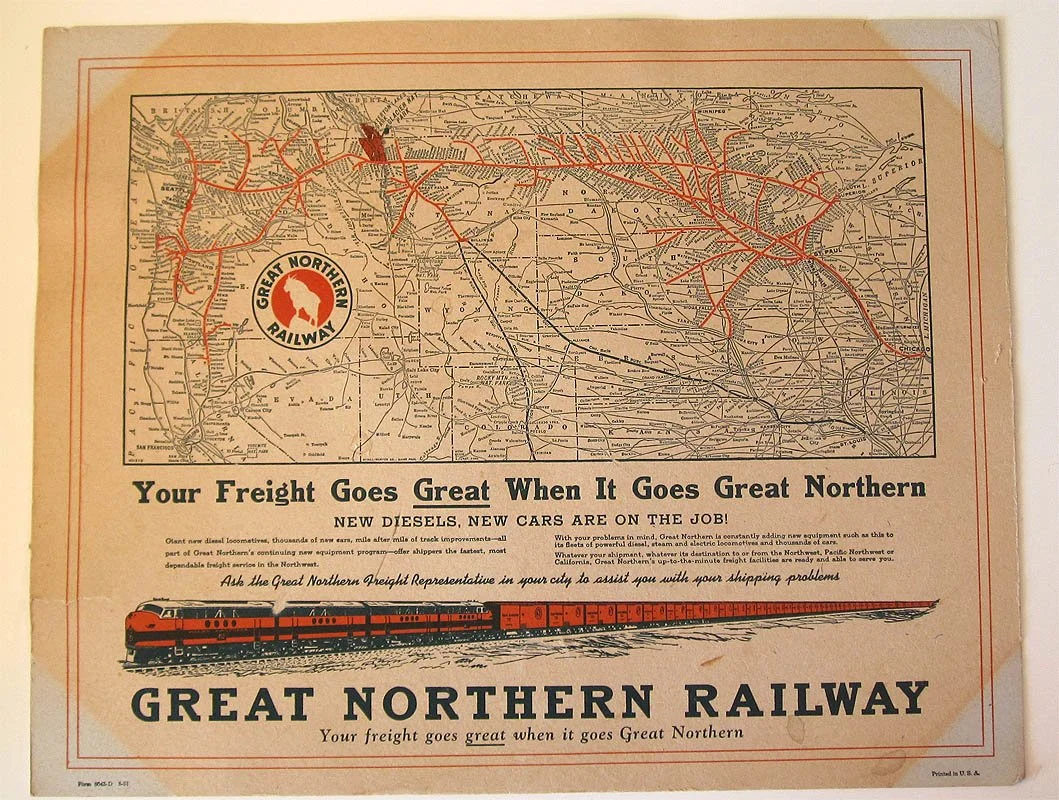
An example of Great Northern Railway blotter paper that includes a map of the route and all the reasons why your freight should “go great” on Great Northern. Image from Railroadiana.org.
And now for the reason I’m even talking about this - I have become the owner of at least two hundred sheets of blotting paper from the Union Pacific’s City of Portland. It was part of a group of trains all with same naming convention “city of” followed by a major city it traveled to (in the photo of my article you can see that one of the papers is from the City of Los Angeles). City of Portland ran from Chicago, Illinois to Portland, Oregon from 1935 until 1971. That makes the paper that I have at least 50 years old, but possibly older based on the design.
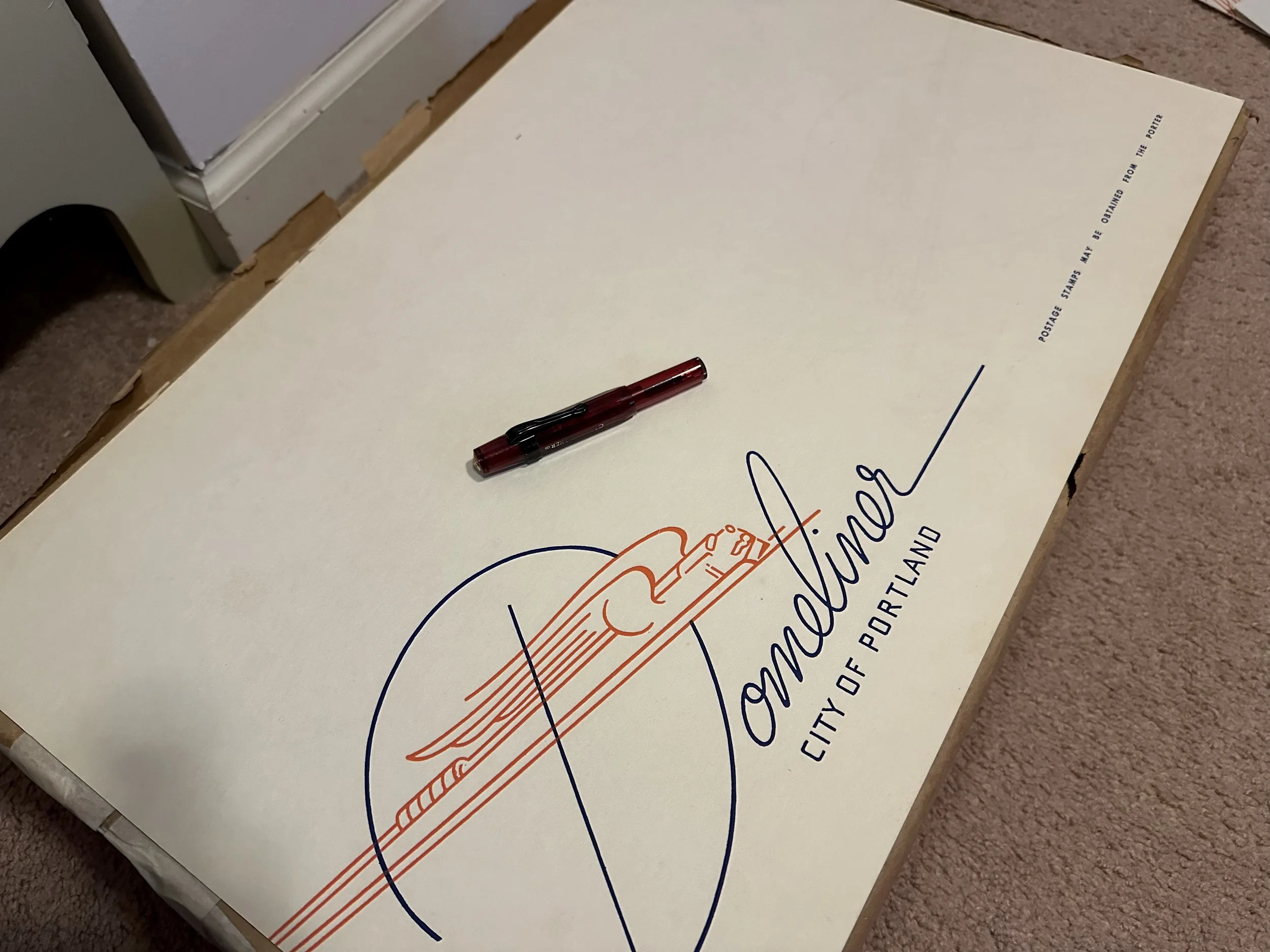
Kaweco Sport for scale.
The City of Portland was a streamliner, a popular post World War II design as it looked very modern in contrast to steam engines and heavyweight coaches. It was the first streamliner that provided sleeping cars which was probably nice for the 40 hours it would take to get from Chicago to Portland. Please note this was the fastest way to get between the two cities prior to air travel.
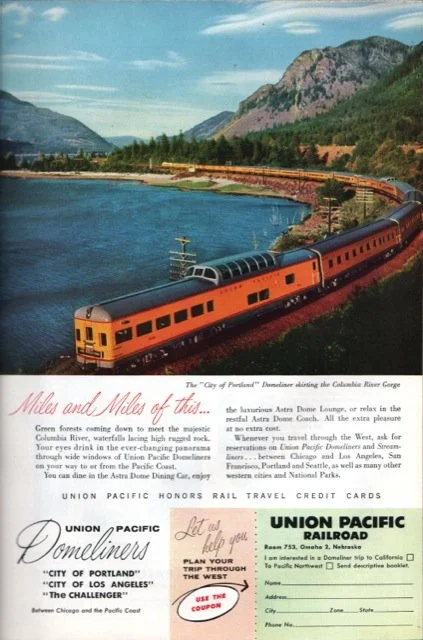
A 1960’s advertisement for travel on the City of Portland and the other Domeliners. Image from: Streamliner Memories
I am guessing that my paper is circa 1960, is because the Dome cars were not added until 1955. Dome cars were kind of a last hurrah for the passenger railroads in the USA, an attempt to claw back travel from air which was becoming more and more common and popular. For those unfamiliar with train terminology, a dome car essentially has a second floor with a glass dome so that passengers can see along the length of the train and get good views of the landscape along the route. A lot of them that have survived retirement are now used on scenic railroads because of the range of view they provide.
A few other clues about the age of my blotting paper is due to the mid-century modern swooping in the design. A minimalist, “streamlined” design aesthetic was preferred as the more detailed and colorful ones were considered “old-fashioned” at the time. I’m also guessing that time frame because of the adoption of ballpoint pens. For example, the Bic Cristal was launched in the United States in 1959. By the late 1960’s, and when this passenger route was retired in 1971, it was probably much more common for train passengers to be carrying a ballpoint.
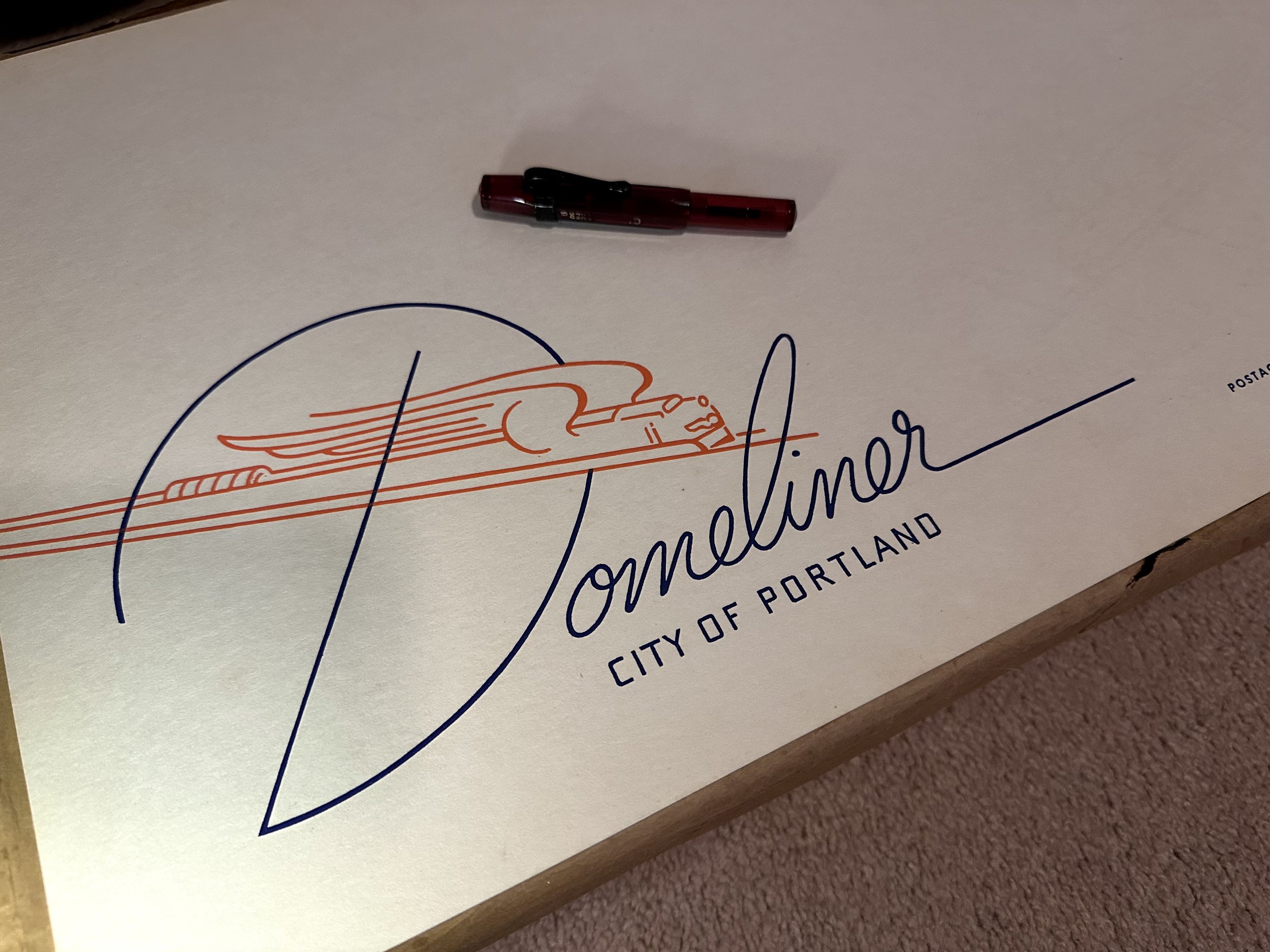
A closer view of the letterpress design.
So, how did I come into possession of 60-ish year old blotting paper? Well, it goes back to that railroad museum connection. Railroad memorabilia collecting is a very passionate hobby. Honestly, it’s not that different from our own stationery hobby when one becomes a fan of a certain brand or maker. Train people can be intense about their favorite railroad and it shows in the sorts of things they collect or hang onto. Many former railroaders kept many items as routes were closed and railroads were consolidated. A ton of this stuff likely ended up in the trash if it didn’t end up in a railroader’s storage space. A donor to the museum who worked for the railroads most of his life is starting to find homes for the different items as he’s getting older. The museum could only take so much blotting paper and I mentioned I would be interested in taking what the museum doesn’t want. Next thing I know I’m being handed a massive Ikea bag with two reams that probably weigh at least 10 lbs each if not more. They are hefty! They are also still in the wrap that they came in from the factory. They were made at the Rand McNally & Co. (the same people who have made a lot of road atlases over the years).
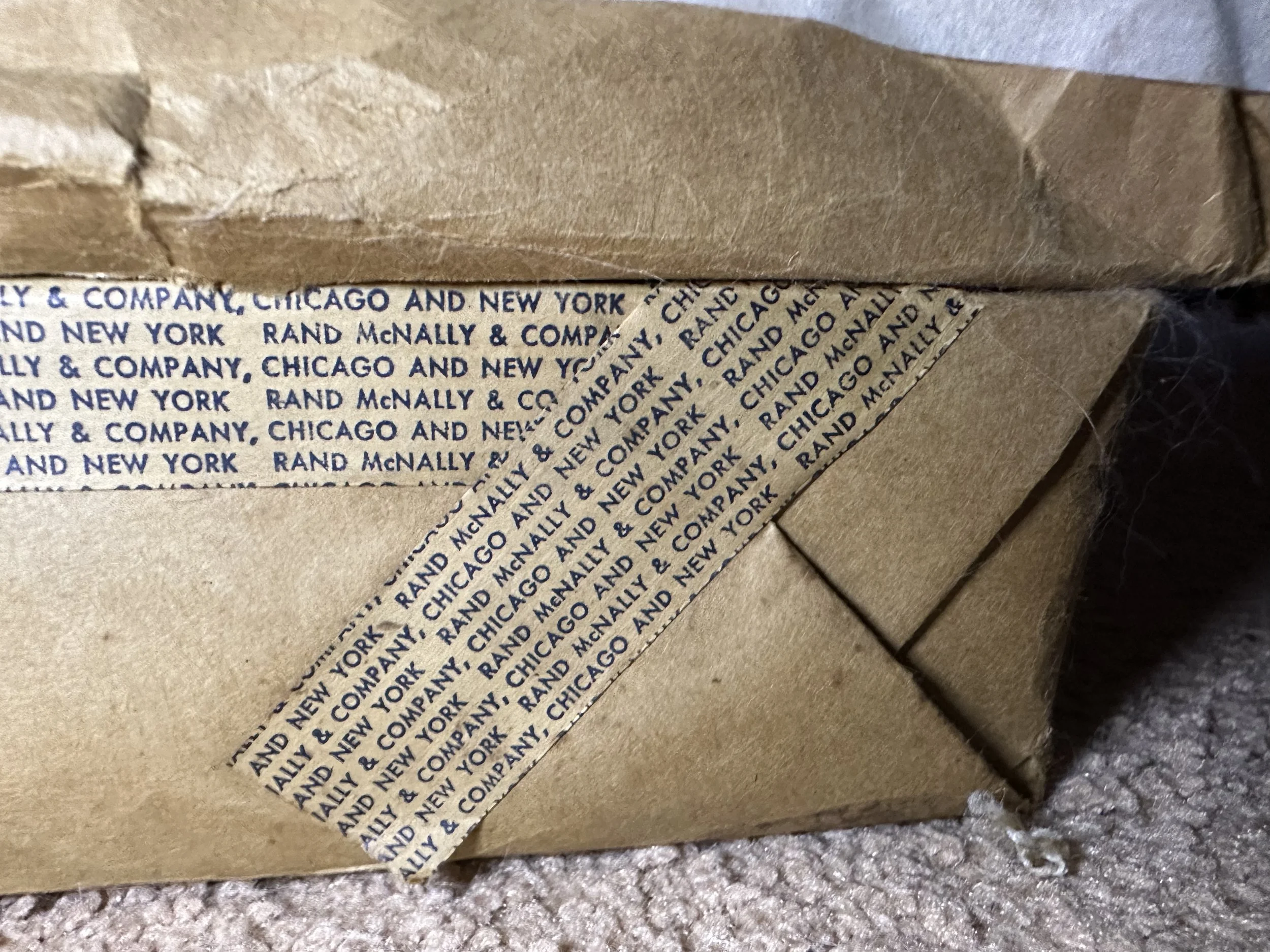
What am I going to do with it? Not a hundred percent sure yet. I have sent some cut down bits to a few of my penpals for them to play with and I am going to be using some myself. I haven’t done a lot of tests with it yet, but it should still work the way it was intended to - absorbing ink. I enjoy letting old things serve their purpose as opposed to just ending up in a dumpster.
As a historian, I really like those little moments where we can tug on the threads of the past. And I offer this little mini history lesson in railroad branding because it made such a huge impact on the way marketing works today. There’s a lot of little random discoveries one came make when just asking questions about something. Pull a thread and you might discover a lot of connections you may never have though about.
Honestly, vintage paper is something pretty interesting to me. It’s extremely difficult to find and even as artifacts in museums they are few and far between. It’s called ephemera for a reason, it was never meant to be held onto forever, it’s “ephemeral” or short-lived. It’s one of the things I love about junk journaling and creative journaling. I get to tuck little pieces of paper that would probably just disappear otherwise in a place that gives them context. My notebooks will likely never end up in an archive, but maybe they’ll end up in a diary collection and provide a little glimpse in the turn of the twenty-first century.
If you’re looking for a new podcast, I recommend Sally’s Diaries. She is a private collector of diaries and journals.
Currently Inked
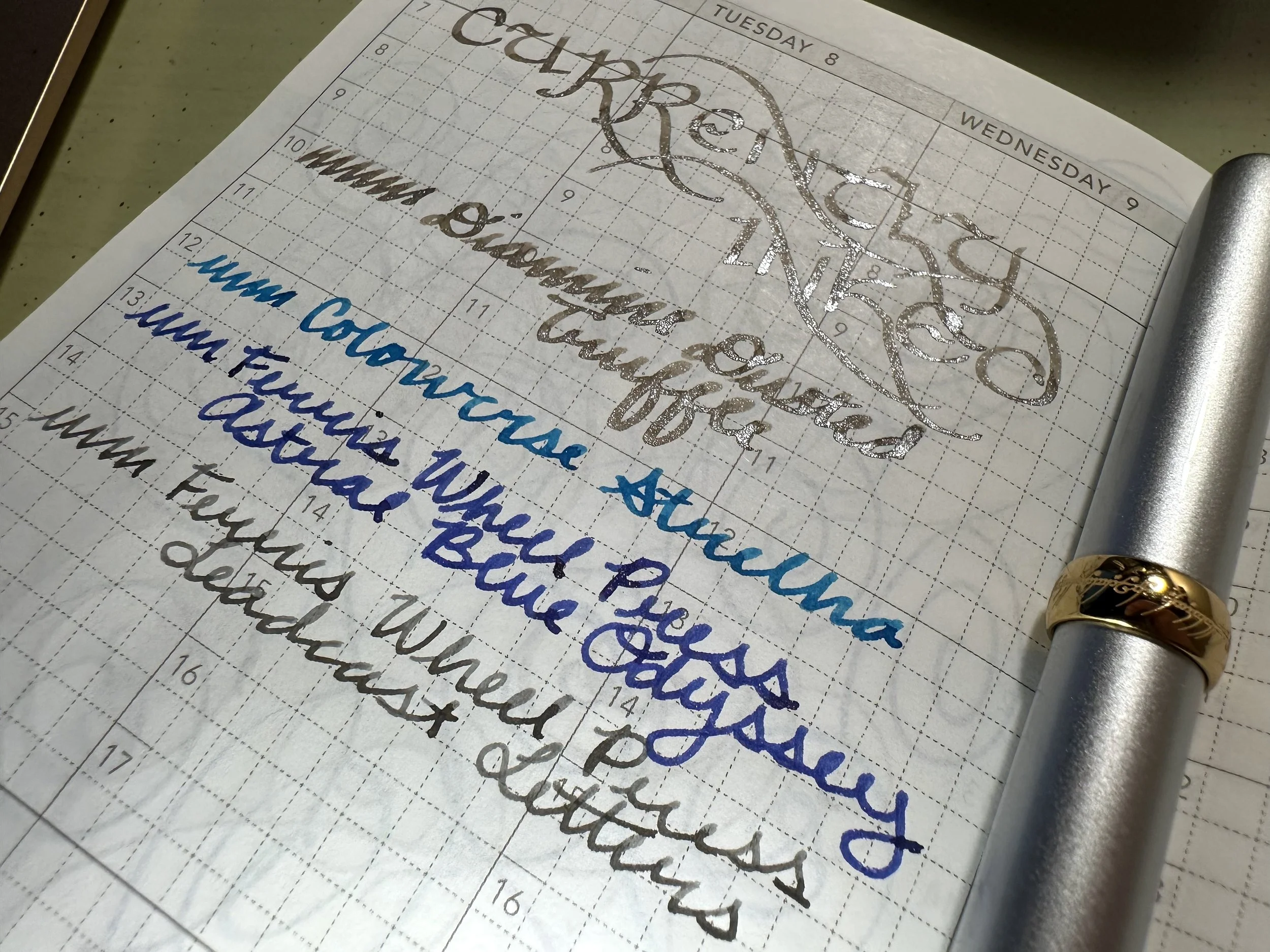
Oof… winter light (or lack thereof) is a doozy to try and get accurate color. Apologies for the pic being a little dark.
Diamine Dusted Truffle - Kaweco x Galen Leather Sport 14K BB ‘journaler’ - I wasn’t sure what color I was going to go with as a header for December. I ultimately decided to go with Dusted Truffle since brown with silver shimmer is a pretty good neutral. I can use a lot of different colors of ink with it and it won’t clash. This ink is also just really pretty. It’s a wet ink so it can be prone to feathering on more absorbent papers, but on fountain pen paper it’s pretty awesome.
Colorverse Strelka - Kaweco liliput fireblue 14K BB CSI - When I was cleaning out my pens this week I decided I was in the mood for a fat nib. The follow up question would be did I want a fat round nib or a fat italic nib. I ultimately decided on this one because I haven’t used it in a while. Strelka is such a great sky blue. It makes me happy every time I put it in a pen. It was actually one of my first Colorverse sets.
Ferris Wheel Press Astral Blue Odyssey - Kaweco liliput copper B - I ended up refilling this pen because I’m really enjoying the bright blue mixed with the copper shimmer. It’s pretty unique in my collection. It’s flowing really well too in the converter.
Still working through:
Ferris Wheel Press x LOTR Gandalf with Ferris Wheel Press Leadcast Letters